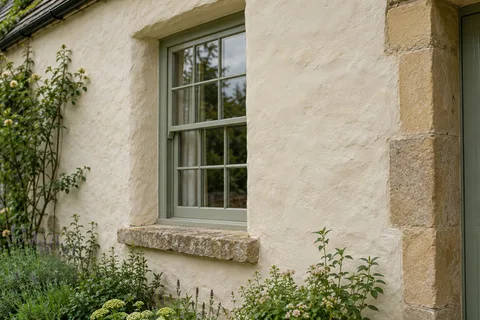
Lime render and older buildings
Lime rendering in Scarborough
Lime render is made with lime instead of cement. It is softer and more permeable, so an older solid wall of stone or soft brick can take up rain and dry out again through its surface. It is the usual repair for traditionally built houses, but it asks more of the weather, and of the people applying it, than a modern cement system.

On this page
Why older walls need it
SPAB explains the problem lime solves. When an older wall is covered with hard Portland cement render, the render is more rigid than the wall, so hairline cracks form; rain is drawn in through them and becomes trapped, because cement restricts evaporation. The wall stays damp, and the cement often fails in patches and comes away. Lime moves with the wall and lets moisture leave, so it tends to wear back gradually and evenly instead.
Around Scarborough this matters for the older stock. The council's residential design guide records brick and render buildings in the Old Town (paragraph 6.20) and says properties in villages on the fringe of the North York Moors are predominantly built of sandstone or limestone (paragraph 6.14). A lime finish on such a building should be patched with lime: IHBC guidance warns against using cement or strong hydraulic lime to patch weak historic lime.
- Stone or brick masonry Cleaned of loose material and dampened so it does not draw water out too fast.
- First (scratch) coat Often haired; scratched to give the next coat a key.
- Second (floating) coat Applied once the first has firmed up; follows the line of the wall.
- Finish coat Thin final coat, kept damp and shaded while it cures.
- Limewash or mineral paint Optional decoration that keeps the wall permeable.
Wall on the left, finish on the right. Not to scale: coats, thicknesses and primers follow the chosen manufacturer’s system and the condition of the wall.
Taking cement render off an older wall
Many old houses carry a cement render added in the twentieth century. SPAB's advice is to remove a small trial area first, by hand with a hammer and, where needed, a chisel, and to see what comes away with it. Levering off large sheets can seriously damage soft brick or stone underneath, and power tools belong only in highly experienced hands. Sound, well-adhered cement is sometimes left to weather.
A stripped wall may be saturated, and SPAB recommends waiting for it to dry before re-rendering. Salts can be drawn out into the new lime, so in some cases the render needs renewing after a couple of years. Decayed bricks, stones and joints are made sound before anything new goes on.
How lime render is built up
Lime goes on in several thinner coats rather than one thick one. Taking K Rend's K Lime range as an illustration: a stipple bond coat is scrubbed into dense stone or brick where key or suction is poor, a coarse coat dubs out hollows in an irregular wall, a base coat follows, and a finishing coat is floated smooth or a roughcast of lime and limestone chips is applied. Each coat has to set enough before the next goes on.
Preparation is wetter than with cement. Lime Green's guidance is to mist the wall evenly about half an hour before rendering and check it draws water in slowly, leaving it just damp; raked-out joints alone do not give enough key. Lime render follows the line of the wall: Lime Green treats a deviation of about 5mm under a 2m straight edge as the limit one or two coats can correct, so a bowed old wall keeps some of its curve.
Trial removal of any cement; let the wall dry and repair it
Mist the wall and test suction before each coat
Stipple or bond coat on dense or poorly keyed backgrounds
Dubbing-out and base coats, each left to set
Finishing coat floated, or lime roughcast applied
Hessian kept close to the work for at least two weeks; limewash later
Curing and protection
Lime mostly fails by drying too fast. Cornish Lime describes plastic shrinkage cracks appearing within the first 48 hours when mixing water evaporates quickly, and later drying shrinkage driven by wind, strong sun and low humidity. Its answer is hessian draped close to the fresh render for at least two weeks, dampened in warm weather. If your wall faces the sea and catches the wind, the hessian and scaffold sheeting are as much part of the job as the render.
Frost is a risk to fresh lime as well, so ask how the work will be protected if cold weather arrives, and expect scaffold and hessian to stay up after the wall looks finished. Decoration waits too: the render needs to dry before limewash goes on.
Finishing and looking after lime
SPAB's preferred finish for lime render is traditional limewash, because its high permeability lets the wall breathe; standard modern paints are usually less permeable and risk trapping moisture. IHBC adds that limewash should never be patched or overpainted with other types of paint. It is simply reapplied as it weathers.
IHBC suggests checking historic walls from the ground as part of an annual inspection, with a closer look about every five years. Watch for bulges, hollow-sounding patches and long cracks running in one direction, which may signal movement in the wall rather than a render fault. Keep gutters and downpipes clear: SPAB notes that render can fail locally where a leaking fitting concentrates water.
Common questions
Is hydraulic lime the same as lime putty render?
No. Natural hydraulic limes set partly by reaction with water and are harder; SPAB advises against strong hydraulic limes on vulnerable walls and suggests a natural hydraulic lime without additives where a faster set is needed. The right lime depends on the wall.
Who do I ask about lime work on a protected building?
The planning authority for the address. Inside the North York Moors National Park that is the National Park Authority, most of whose conservation areas carry Article 4 directions; outside the Park, ask the council that covers the address. Ask before stripping or changing render.
See housing and planning information for Scarborough and nearby places, including the source and geography behind each figure.