Monocouche finishes
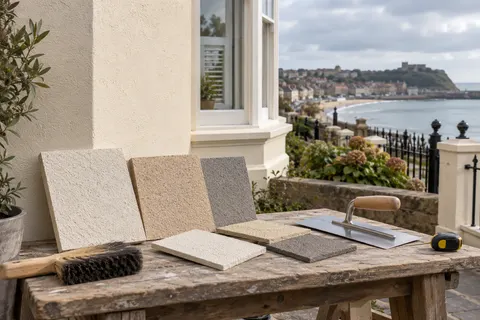
Monocouche rendering in Scarborough
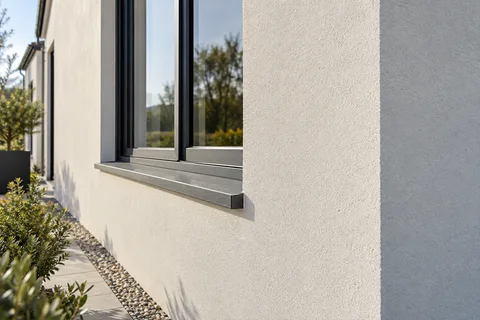
Monocouche, French for single layer, is a factory-mixed, through-coloured cement render applied in one thick coat and scraped back to a fine texture once it has partly set. It is mostly used on new blockwork, such as extensions and new-build walls, where it replaces the traditional base coat and painted finish with a single coloured layer.

On this page
What you are buying
Take K Rend's K Mono as an example. It is a cement-based, polymer-modified render sprayed onto the wall to about 17–18mm, ruled flat and left 3–24 hours to set before being scraped. Scraping removes the surface skin and exposes the coloured aggregate, leaving a finished coat of about 16mm and never less than 15mm. A roughcast version is applied in two passes instead and left rough.
The appeal is that colour runs through the whole thickness, so a scuff does not reveal a grey layer, and there is no painting. Products differ, though: Weber describes its weberpral range as one-coat renders applied in two passes, and K Rend's Silicone K1 can go on in one pass over a base coat. Read the data sheet for the product named in the quote, not a general description of monocouche.
- Background Usually blockwork or brick; uneven or mixed walls may need a levelling coat.
- Beads and mesh Beads at corners, reveals and the base; mesh over junctions and lintels.
- Monocouche passes One through-coloured material, applied in passes to the specified thickness.
- Scraped surface Scraped once partly set, which removes the skin and leaves the texture.
Wall on the left, finish on the right. Not to scale: coats, thicknesses and primers follow the chosen manufacturer’s system and the condition of the wall.
Good uses and poor ones
Monocouche suits sound new blockwork of moderate to low strength, which is the background K Rend designed K Mono for, and new extensions where you want the walls coloured to match or contrast with the house. On the town's later suburbs, which the council's design guide describes as brick with some render, it can finish a new side or rear extension so that it reads as part of the same family.
It is a poor fit for old solid walls and timber-framed walls, which need to dry outward through a softer lime render. As a thick, stiff coat it also needs a stable, consistent background. Dense or smooth surfaces, painted walls and old render usually need removing or a base coat first, and the manufacturer's substrate guidance decides which.
Application, day by day
Beads come first: angle beads on corners, stop beads at reveals and a bellcast or drip bead above the damp-proof course, because a 15mm coat needs a fixed edge to work to. Mesh goes into the render at window and door heads, where cracks tend to start at the corners of openings. The render is then sprayed or hand-applied across a whole face, ruled flat and left alone to set.
Scraping is the critical day. K Rend's sheet says the coat is ready when a thumb no longer leaves an impression and the aggregate scrapes away cleanly without sticking to the blade. Every area must be scraped at the same stage: scraping early leaves darker patches, scraping late leaves lighter ones. On a large gable that means enough hands to scrape the whole face inside the same window.
Fix beads at corners, reveals and above the DPC
Embed mesh at opening heads and other stress points
Spray or trowel to about 17–18mm and rule flat (K Mono)
Leave to set, typically 3–24 hours depending on wall and weather
Scrape the whole face at one stage of readiness; brush down
Protect from rain, frost and direct sun while it hardens
Weather and the coastal frontage
K Mono should not be applied below 5°C or above 30°C, if frost is forecast within 24 hours, in damp conditions, or onto an elevation in direct sunlight, and the wall itself must be above 3°C. Sun and wind both change the setting time, which is why the scraping window moves. A sea-facing face that gets sun in the morning and wind in the afternoon can set unevenly unless it is sheeted.
Uneven setting shows as banding in the colour once the face is scraped. If the weather turns before scraping, the team has to decide whether to keep going or stop at a bead line, so ask where the planned stopping lines are on each elevation before work starts.
Cleaning and reviving the colour
Algae will grow on any render that stays damp, and a pale colour on a shaded north face shows it first. Clean scraped render the way K Rend suggests for its finishes: treat growth with a biocide, then wash with water and mild detergent on a wide-fan pressure setting, from the top down. A narrow, high-pressure jet can damage the surface.
Monocouche is not meant to be painted routinely, but faded or patchy scraped render can be revived. K Rend's Colour Enhance is a coating made for existing scraped render: the wall must be cured, dry and repaired, algae treated and a test panel tried, then two coats go on by brush or roller. That is a respray decision, made once the render itself is sound.
Common questions
Can monocouche go straight onto old render?
Usually not. A thick cement coat needs a sound, consistent background, so old render that is hollow, painted or cracked normally comes off first, and anything retained is checked against the product's substrate guidance.
Why is my new monocouche patchy in colour?
Often because areas were scraped at different stages of set; K Rend warns that early scraping darkens the shade and late scraping lightens it. Natural materials can also vary slightly between batches, which is why a site sample panel is recommended.
See housing and planning information for Scarborough and nearby places, including the source and geography behind each figure.