Render recolouring
Render respray and colour changes in Scarborough
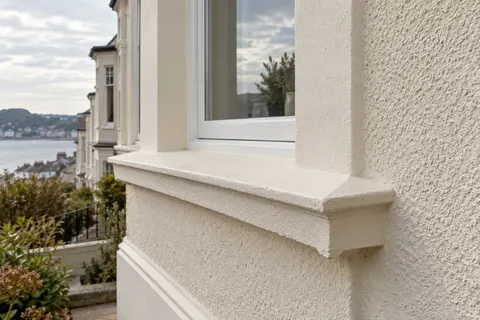
A render respray is a coloured coating sprayed or rolled over existing render that is still sound. It changes the colour and evens out patches and weathering, but it keeps the existing texture and relies entirely on the render underneath being well bonded. It is a refresh, not a repair.

On this page
When a respray is the right job
It suits render that sounds solid when tapped, has no more than hairline cracks and simply looks tired: faded colour, repairs in slightly different shades, stains that wash off, or a colour you no longer want. Painted sand-and-cement render and dull scraped monocouche are typical candidates, because recolouring avoids hacking off render that is still doing its job.
It is the wrong job if render is hollow, bulging or cracked across the face; a coating will not stick loose render back onto a wall. Deal with those areas first through render repairs or re-rendering. It is also wrong on lime render, where SPAB recommends limewash rather than modern paints that risk trapping moisture.
- Clean Washed down, with algae and mould treated and left to work.
- Repair first Cracks and hollow patches are repaired before any coating.
- Prime or stabilise Where the coating maker requires it on that surface.
- Coating Usually two coats of a breathable masonry or silicone coating.
The usual order of work. The survey and the chosen products decide the actual steps.
Preparation decides the result
K Rend's instructions for its Colour Enhance, a coating made for existing scraped render, set out the order most coatings follow. The render must be fully cured, dry and free of loose or flaking material, unsound coatings, oil, soot, lichen and dust. All repairs are done first, algae and mould are treated with a biocide, and a test panel is applied to check colour and appearance.
Cleaning is usually a low-pressure wash rather than a jet that could damage the surface, followed by drying time. Cracks are opened and filled, hollow patches cut out and re-rendered, and the repairs allowed to cure. A coating unifies colour across repairs well, but it will not hide a change in texture or a patch that stands proud.
Masking and spraying
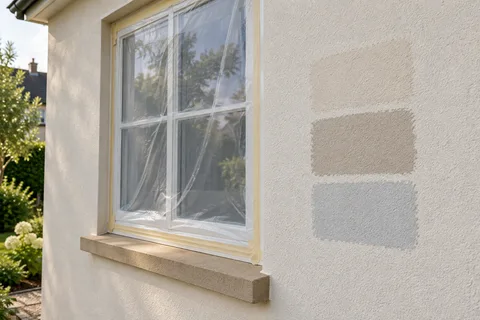
Spraying is quick but puts a fine mist in the air, so masking is a big part of the job. Windows, doors, sills, timber, brick and paving are covered with polythene and tape, and cars are moved. Spray drifts in wind, which matters on an exposed sea-front elevation or next to a neighbour's car; on those days or faces, rolling or brushing can be the better method.
Most render coatings go on in two coats. K Rend's Silicone Masonry Paint, for example, has a first coat thinned with up to 10% water and an undiluted second coat applied 8–12 hours later, and it should not be applied below 5°C or above 30°C. Each elevation should be coated from one batch so the colour stays consistent.
Tap-test; repair hollow or cracked areas
Treat algae with a biocide; wash at low pressure
Let the wall dry fully
Mask windows, doors, sills, paving and planting
First coat (often thinned), then a full second coat
Remove masking, touch in edges and refix fittings
Choosing the colour
A new colour changes how the house sits beside its neighbours, its windows and its roof. Try a sample on the actual wall and look at it in morning and evening light; a small card held against textured render gives a poor idea. Pale colours show dirt and algae sooner, and dark colours absorb more sun.
Colour matters to the street as well as the house. On Foreshore Road, the council's design guide names white render and painted frontages as part of the area's character. In a conservation area, or inside the North York Moors National Park where most conservation areas carry Article 4 directions, check with the planning authority before changing the colour of a front elevation.
Aftercare
A coating protects and refreshes sound render; it does not stop the render ageing. Keep gutters clear, treat algae with a biocide when it appears and recoat when the colour fades. Keep the product name, colour reference and batch number so a later touch-up can be matched as closely as possible.
If marks keep returning in the same place, look for the cause before recoating. A stain below a sill or downpipe usually means water is being directed onto the wall, and paint will only cover it for a while.
Common questions
Can pebbledash be resprayed?
Sound pebbledash can be coated, but the stones make even coverage slow and loose stones must be dealt with first. Re-dashing over it, or [removing it](/pebbledash/), are the alternatives if the surface is poor.
Is respraying the same as rendering?
No. A respray adds a thin coloured coating to the existing render. Rendering applies new render coats, usually after removing the old ones, and can change the texture and fix failed areas that a coating cannot.
See housing and planning information for Scarborough and nearby places, including the source and geography behind each figure.