Practical guide
Faded render: clean, coat or replace?
Render that looks tired may only need cleaning, may need a new coating, or may need replacing. The difference lies in whether it is still sound. A quick tap test, a look at the cracks and a check on what is causing any marks will usually show which route the wall needs.

On this page
Start with the tap test
Tap the render at intervals with a knuckle or the handle of a screwdriver, as far as you can safely reach. Sound render gives a solid knock. Where it has parted from the wall it sounds hollow and may bulge; IHBC uses the same test to find detached render on historic walls. Mark the hollow areas in chalk and photograph them.
If almost everything sounds solid, the render is doing its job and the question is appearance: clean or coat. If hollow areas are scattered, repairs come first. If most of a face sounds hollow, that elevation is a candidate for replacement, whatever its colour.

A mixed answer is often the right one
A house rarely needs one treatment everywhere. For example, a hypothetical semi might have a sound front that is just dirty, a rear wall with two hollow patches below a leaking downpipe, and a side wall that is fine. The sensible job is a clean on the front, a defined repair at the back once the downpipe is fixed, and nothing on the side.
Writing the work down elevation by elevation keeps that clear. It also stops a colour change you want being confused with a repair the wall needs, and lets you decide what can wait. Deferring a new colour is a choice; leaving hollow render to fall is not.
Cleaning
Cleaning suits sound render whose colour is basically right but dulled by algae, dirt or streaking. K Rend's maintenance advice for its finishes is to treat algae with a biocide, then wash with clean water and a mild detergent using a pressure washer on a wide fan setting, from the top down. High-pressure jets can damage the surface.
Expect cleaning to reveal as well as remove. Old repairs, slight colour differences and fine cracks hidden by dirt may become more visible on a clean wall. Try a small area first and judge it dry.
A new coating
Recolouring suits sound render that is faded, patchy or the wrong colour. The wall is cleaned, algae treated, repairs completed and cured, and openings masked, then two coats are applied. K Rend's instructions for its Silicone Masonry Paint, for instance, call for a first coat thinned with up to 10% water and an undiluted second coat 8–12 hours later, between 5°C and 30°C.
For scraped render that has dulled, K Rend makes a coating called Colour Enhance specifically for existing scraped surfaces, applied in two coats by brush or roller after a test panel. Recolouring evens out colour across repairs but keeps the existing texture, so a patch that stands proud will still show in low sunlight.
Replacing the render
Replacement means hacking off the failed render, repairing the wall and applying a new system. It is justified where much of a face is hollow or cracked, where water is getting behind the render, or where you want a change of texture that a coating cannot give, such as smooth render in place of pebbledash.
Replacing the render layer is renovation under Approved Document L. When renovation exceeds half of an elevation or a quarter of the external building envelope, it can require an insulation upgrade where it is feasible, so ask about it before deciding. On an older solid wall, the replacement should usually be lime, and removing old cement needs a careful trial first, as SPAB advises.
Painted sand-and-cement render
Where older render is site-mixed sand and cement, applied in coats and then painted because it has no colour of its own, the paint does much of the visible work, and when it fails it flakes, chalks or peels while the render underneath may still be sound. Recoating is then a matter of removing loose paint, repairing and recoating, not replacing the render.
The warning signs that the render itself has failed are different: hollow sounds, bulges, cracks wide enough to catch a fingernail and patches that stay dark after rain. A wall can have both problems at once, which is why the tap test comes before any choice of paint.
Pebbledash and other textured finishes
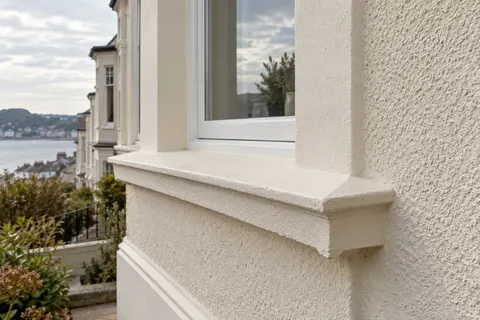
Dashed and roughcast walls are harder to clean and slower to coat evenly, because the stones hold dirt and cast shadows. Sound dash can be coated, or re-dashed in a new colour; K Rend makes an overcoating dash receiver designed to go over existing dry dash without a new base coat. Dash that is hollow or shedding stones is a removal job.
If what you really want is a smooth wall, neither cleaning nor coating will get you there. That means removing the dash and re-rendering, which is the largest of the three routes.
Comparing the three
Set the options side by side for each elevation: what the wall's condition is, which treatments are suitable, what each involves and what the finished wall will look like. Leave out anything the survey rules out and note why. A respray and a re-render are different jobs, so compare what each achieves, not just their scale.
Remember that the cause of any marks has to be fixed whichever route you take. A stain below a sill will come back after cleaning, after recoating and even after re-rendering if the sill has no drip.
Keeping the result
Keep the product name, colour reference and batch number of any new coating or render. Clean gently when algae returns and recoat painted render before the coating wears through. The Scarborough rendering homepage brings together the services if the survey points to a different type of work.
Common questions
How do I know if render is beyond recoating?
If large areas sound hollow when tapped, bulge, or have cracks wider than a hairline running across the face, a coating will not hold them. Those areas need repair or replacement first.
Will a new coating hide old patches?
It will unify the colour, but not the texture. A patch with a different surface or one that stands proud will still show, especially in low, raking light.
See housing and planning information for Scarborough and nearby places, including the source and geography behind each figure.