Practical guide
Cleaning growth from render without harming the finish
Green algae, black mould and grey grime on render are mostly surface growth, and most of it can be cleaned off without harming the finish. The two mistakes are using too much pressure and cleaning without asking why that patch keeps growing. Identify the finish first, then choose the gentlest method that works.

On this page
What is growing and why there
Algae shows as a green film, mould as dark spotting and lichen as crusty patches on older surfaces. K Rend's maintenance advice notes that algae will grow on any surface that stays damp for long periods, and that walls near woodland or other sources of spores are more prone to it. Growth is a symptom of a wall that stays wet.
Look at the pattern before cleaning. Growth concentrated under a sill, beside a downpipe or along the base of the wall points to water from that detail. An even film over a whole shaded elevation is usually just the wall's position. The first may need a repair as well as a clean; the second needs only a clean and perhaps a treatment to slow regrowth.

Identify the finish before you clean it
Different renders tolerate different treatment. A silicone thin coat has a biocide built in and a water-repellent surface that usually washes well. Scraped monocouche has an open texture that a narrow jet can damage. Painted sand-and-cement render depends on the paint, which may be near the end of its life. Lime render and limewash are soft and should not be blasted; limewash is renewed rather than scrubbed back.
If you know the product, look up its maintenance guidance. If you do not, say so to whoever is cleaning it, and test on a small, inconspicuous area first. Old invoices or a note of the last decorator can save guesswork.
The cleaning method
The usual sequence is biocide first, then a gentle wash. K Rend recommends treating algae with a biocide or algaecide and cleaning with a pressure washer set to a fan spray rather than high power, using clean water and a low concentration of mild detergent, working in a controlled way from the top of the wall to the bottom. It warns that very high-pressure washers can damage the render surface.
Follow the biocide's own instructions on dilution, how long to leave it before washing and the weather it needs. Heavy rain soon after application can wash a treatment off before it has worked, so a dry spell is worth waiting for.
Trial area first
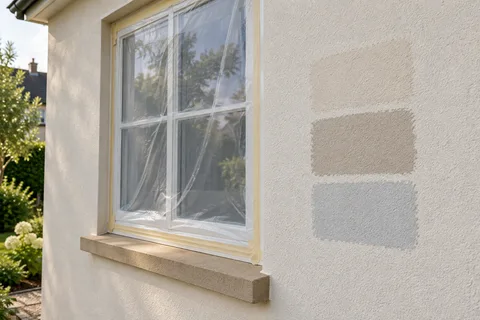
Try the method on a small patch, ideally one that represents the worst growth and the normal finish. Let it dry fully before judging it: wet render always looks darker and cleaner than it will when dry. Compare it with an untreated area in similar light.
A good trial tells you three things: whether the method removes the growth, whether it marks or softens the surface, and whether it reveals anything underneath, such as old repairs, a failing paint layer or cracks. Cleaning often makes earlier patches more visible, because the dirt that hid the difference has gone.
Access, run-off and protection
Cleaning above ground floor is work at height, and a long lance from the ground is not a safe substitute for proper access on a tall elevation. Tell whoever is doing it about conservatories, lower roofs, narrow passages and planting below the wall.
Biocide and dirty water run down the wall and into beds, ponds and drains. Plants close to the wall need covering or wetting first, and windows, doors and vents need closing or protecting. Ask what product is being used and how run-off will be managed, especially near a pond or a neighbour's garden.
Cleaning, repairs and recolouring
A clean is not a repair. If cleaning reveals cracks, hollow areas or flaking paint, those need dealing with separately, and the wall may then need recoating. If the colour has faded unevenly, recolouring after cleaning can even it out: K Rend's Colour Enhance for scraped render, for example, requires algae to be treated before it is applied, and all repairs to be completed first.
Where growth keeps returning in the same place, fix the cause. A leaking downpipe joint or a sill without a drip will keep that patch wet however often it is cleaned. SPAB's advice is to clear gutters after the autumn leaf fall and check rainwater fittings for leaks in heavy rain.
A worked example
For example, take a hypothetical guesthouse with a pale silicone-rendered frontage facing north and a scraped monocouche side wall beside a row of trees. The frontage has an even green film; the side wall has heavy growth along its base and a dark stripe under one downpipe.
The frontage might need only a biocide treatment and a gentle fan wash from the top down. The side wall needs the same, plus a look at the downpipe joint and at the ground level along its base, and perhaps the trees cut back. If the monocouche looks patchy once clean, a coating designed for scraped render could follow after a dry spell. Three problems, one visit, and only one of them was really about cleaning.
Keeping it clean
K Rend suggests light cleaning after a few years for its finishes, depending on weathering and spores in the air, rather than a fixed interval. It also sells a water-repellent treatment intended to keep render cleaner for longer; ask whether any such product is compatible with your finish before applying it. On lime render, SPAB advises avoiding colourless water-repellent treatments altogether, because their long-term effects are unknown.
Cutting back overhanging trees and shrubs that keep a wall shaded and damp slows regrowth more than any product. The Scarborough rendering homepage brings together the services if the clean shows the render needs more than washing.
Common questions
Can I pressure wash render myself?
On a low wall you can reach safely, a fan setting at low pressure with a mild detergent is the method K Rend describes. Avoid a narrow, high-pressure jet, which can damage the surface, and do not work from ladders with a pressure washer.
How often should render be cleaned?
There is no fixed interval. K Rend suggests light cleaning after a few years depending on weathering and airborne spores, so a shaded wall near trees may need it sooner than an open one.
See housing and planning information for Scarborough and nearby places, including the source and geography behind each figure.